Introduction digital technology 2 Introduction digital technology 2
We have assumed that when we start saving, we were not talking about an entire complex text or program, but just numbers. Let's stay with Konrad Zuse's relays for a moment. What range should they cover, only two from
0 to 255 or one from 0 to 65535?
How are the figures calculated? You use eight relays (bits) to store data once, and then 16. Thus, one bit results in two states: 0 and 1, two bits result in four: 00, 01, 10, 11 and three bits result in eight: 00, 01, 10, 11, 100,
101, 110 and 111 etc.
If you add zero, only 255 remain. With 16 bits, the doubling continues merrily. As you can see, from the outset, the focus was on a type of switch, even though the tubes and transistors used later could also have stored
intermediate values.
The number of relays that need to be placed next to each other depends on the scope of the numbers. There are also relays that require continuous current when switched on. If the power is turned off, all relays are set to
'off'.
Then the stored information is gone. This would be roughly equivalent to the working memory in a computer. However, it is also possible to retain them. Just think of switches on model railways.
They are also electromagnetically operated, but remain in their state when the power is off.
The technical realization has therefore forced us to use the binary system. But don't worry, the decimal and other systems can be easily converted. We no longer even notice that our computers operate according to this
system.
The exchange of information has become much more important in the meantime. Let's assume a sensor that measures temperature, in the simplest case as voltages between 0 and 5 volts. In the
analog case, it would pass this on to an instrument with a pointer that could be read on the dashboard, perhaps with a red area.
Digitally, the sensor either transmits the voltages to a control unit or converts them into binary values itself. Let's say that with 8 bits, 5 volts corresponds to the value 255 and 0 volts corresponds to the value 0. During
the conversion, intermediate values that the instrument would have displayed are lost.
This is typical for digital systems, which is why we refer to them as 'discrete'. Would the intermediate values have been necessary? Of course not, because you only look at the instrument at certain moments anyway. But
what would be more necessary?
It's clear that you would be warned, for example, even at low temperatures, if you were putting too much strain on the engine. But only a microprocessor that also monitors the engine speed can do that. But what is exciting
is how the values are transferred.
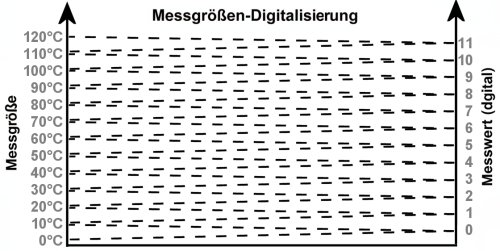
At the top of the image, you can see how measurements in °C are converted into digital readings. You simply add up, for example, 10°C in each case. All values from 0 to 10°C receive the measured value 0, from 10°C to
20°C the value 1, and so on, in this case up to 120°C.
If one were to add one negative and three positive values up to 150°C, the number of measured variables would increase to 15. This fits exactly for 4 bits, which would have to be transferred in each case. Then
you would still have to define the pauses between accesses.
|