Life will be beautiful.
kfz-tech.de/YKfz8
In the chapter “Life is beautiful,” we praised car manufacturers (for once) for what they have achieved in 120 years. It was therefore a very successful look back at the past.
In the next chapter, 'Supermarket Parking Lot', we found that people were so preoccupied with the stress of shopping that it is difficult to imagine that they could derive any additional benefit from the software-based car.
In this chapter, we want to take a look into the future. After all, car manufacturers must have thought of some benefits when developing such cars, explicitly including benefits for drivers, not just for themselves.
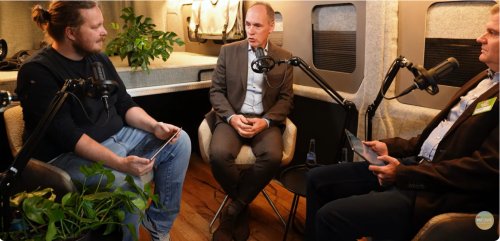
Yes, they did. However, we don't want to deal with infotainment right now, but are looking for very tangible advantages. The YouTube channel Moove really helped us get ahead with its interview with expert Christoph Keese
(linked below).
His first statement not only calls for proper digitization, but also takes a look at the institutions affected. He appeals for understanding for this and thereby warns against disregarding their experiences and wanting to
change them at a rapid pace.
His remarks on the 'innovator's dilemma' and then also on nuclear fusion and its potential as an investment are truly worth listening to. And then, quite suddenly, the discussion shifts to a point that touches on our topic.
To date, we did not know that Starlink could achieve latency times of 20 ms, which, according to ChatGPT, would be only 1.5 ms for mobile communications (4G), although Mr. Keese assumes that 5G will be available at
almost every point on earth.
The way in which the transition from terrestrial network technology via radio masts to one via satellites, together with antennas that can be built into smartphones, is predicted for the future is truly impressive.
It takes a long time, as we are doing now, to get to our topic. We would like to add one more point, namely that an entire industry is likely starting a journey with software-based cars, without knowing whether it will be
successful.
We've been waiting for it, and now it's finally here: the acknowledgment of one of humanity's fundamental needs, namely mobility, or in other words, the car. The distinction from other modes of transport is interesting.
You can achieve something with a car that you cannot with any other means of transport.
Have you ever wondered how members of any government manage to check into Washington in the evening, for example, and show up there bright and early in the morning? Of course, they sleep on the plane
and have full service for their morning toilet.
This is only possible to a limited extent in a car, and not every sales representative can afford a chauffeur. That's why the field surrounding software-based cars will automatically become huge once we have autonomous
driving.
To top it off: once the 20 ms latency time has become common knowledge among developers, the calculation of whether there is a full or empty cardboard box lying on the street can
be safely left to a calculation in the cloud.
Can you now guess why data centers in the US, for example, consume a third of the electricity? Then the computer in the car slowly becomes a terminal, at least as long as it does not have any tasks to perform that
affect driving safety, for example.
In summary: There will be no transportation system that can take you from your home to your exact place of work without changing means of transport and possibly detouring around traffic jams, and do so comfortably and
quietly if the development of e-mobility continues as it has been.
kfz-tech.de/YKfz9
|