Everything Is Software 2 Everything Is Software 2
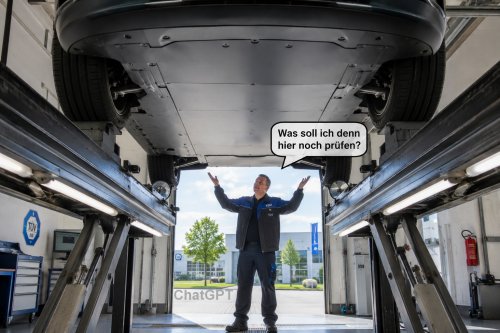
The TÜV Rheinland employee is standing under our car and asks, “What am I supposed to inspect here now?” We don't know either, because he had already said that cars that are three or five years
old don't actually need to be inspected.
If his superiors hear about this, he probably won't be able to stay much longer. That's because, together with other lobbyists in Brussels, they tried to get permission to inspect cars that are 10 years
old or older every single year, fortunately without success. After all, cars like these are more likely to break down than to cause accidents due to technical defects.
During the sales pitch, they said that although the new car would need to be inspected every year, the cost would be only €100 in the first year, €200 in the second, and €300 in the third. In fact, though,
it was over 130 € in the first year and over 250 € in the second, and it would probably have been over 360 € by now in the third year.
Yes, they changed the brake fluid in the second year and were planning to service the air conditioning now. But it still works great. Back when we had our Golf, we didn't have it inspected until seven
years had passed, and it wasn't even missing a third of the refrigerant, and probably even less oil.
By the way, it wasn't more expensive just because a little more refrigerant had to be added. And that's probably how it will be with our E-Kona, too. And a system like this is tested in a similar way—you
turn it on and see for yourself how it works, only this time using actual measurement data.
You could tell that the Golf's cooling performance was slowly starting to decline. As I said, partly because of the oil level, which is important for the compressor's service life, you should go ahead and
take action. There are good tutorials on YouTube, for example, on how to change various filters.
Surprisingly, there is one company that doesn't specify any inspection intervals at all: Tesla. And yet, the eight-year warranty remains in effect. We still wouldn't have wanted to buy a Tesla
anyway, but this example does show that visits to the repair shop don't necessarily have to be contingent on the warranty.
Now, Tesla is certainly not a model brand when it comes to durability; in fact, it often falls short during TÜV inspections. The examiner's comments made above presumably do not apply to these cars. The
car doesn't shy away from damage, such as to the suspension.
In our case, the inspection, after checking the brakes and lights and reading the error log, was limited to minor visual inspections. And there was one more surprise in store at the end, because for the first time,
this type of inspection was cheaper than the previous one: just over 60 €, whereas the one for a car with combustion engine would have cost about 166 €.
And what does that have to do with our title, “Everything Is Software”? Perhaps we should have been a little more careful in how we phrased “Almost everything is software". But surely it has become clear that, even when it
comes to inspections and TÜV testing, there has been a significant shift toward software.
This will probably go much further. That's because the reviewing instances are now protesting that the only information available to them for their review is the error log. And we all know what an unreliable thing this is,
certainly not a completely reliable source for as many security-related flaws as possible.
In the long run, manufacturers and suppliers will have to provide more information so that practical testing can ensure, for example, that emergency braking does not occur unexpectedly on the highway
or that such situations must be properly addressed.
| As you can see, diagnosis and treatment have exclusively to do with software. |
|