API Access Blocked 1 API Access Blocked 1
kfz-tech.de/PSD5
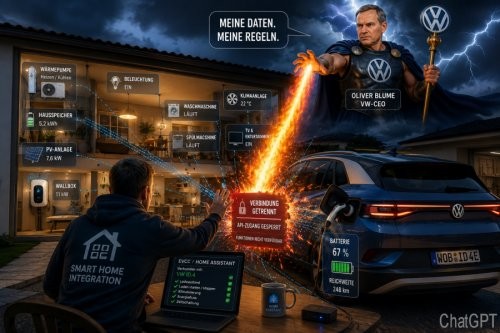
The headline: VW blocks API for external charging control. Why is VW doing this? Is it to make more money? What do the three letters 'API' actually stand for? First of all: It's the abbreviation
'Application Programming Interface'.
And perhaps, before we explain this system, let's take a look at the consequences of this shutdown. It's important to know that the people complaining now aren't weirdos, nor are they people
who are constantly tinkering with their cars to get more performance out of them.
They have simply invested their efforts in software, automation, and energy management, which are now losing some or all of their foundation. This could be a solar panel system on the roof
or a special wallbox.
It could also involve an Electric Vehicle Charge Controller for smart charging of electric vehicles, designed to allow users to control the charging process at
the wallbox, developed by an active community as an open-source project.
However, it could also be a home assistant that has been carefully customized to the specific home environment as a central control system, also an open-source and free software solution with
broad device support.
Let's start by reading the battery level (SoC). There was an option to find this out via the VW server and the EVCC/Home Assistant. No dongle was needed for this; it worked worldwide
and even when the car was 50 km away.
The loss resulting from the API being shut down is likely to be much greater when the system can no longer control the charging process from home—for example, when the PV system is
currently supplying a surplus but there is no more free capacity in the home storage system.
Assuming we're dealing with a smart meter or corresponding software, it is no longer possible, at least not from the home, to start charging when electricity rates are low or to stop charging
when rates are high without an API.
What's particularly troubling is that no charging will be possible beyond a certain, definable percentage. A smart wallbox could also handle the start and end of charging, but stopping the charge
at a specific percentage is likely to be more difficult.
Of course, you can still set the pre-conditioning in the car, for example. But from a distance, this would likely be much more difficult, if not impossible, without an API. It will also no longer be so
easy to find out the vehicle's status from the outside.
The main problem does not seem to be that charging from external sources can no longer be controlled, but rather that the vehicle is no longer a fully integrated part of what was once a complete
energy system.
Perhaps what worries owners of current vehicles even more is the thought of what a manufacturer could do to their vehicle with a simple OTA update. With Tesla, that used to be
simply the significant limitation on charging capacity or range.
|