Brake in general 1 Brake in general 1
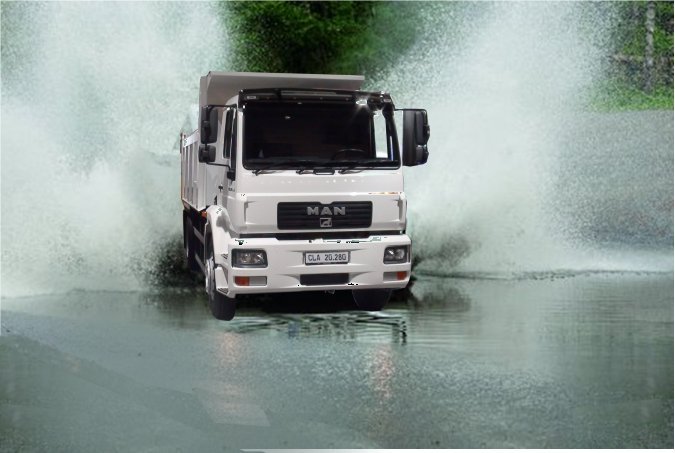
| Due to its smaller tire contact patch in relation to its weight, the truck is less prone to hydroplaning.
|
There's a lot of waggling and subtle comments about the steering, which is sometimes a little too direct and sometimes doesn't help you develop a feel for the road. But driving a car is primarily about longitudinal
dynamics. After all, as a driver, it's up to me how fast I drive through a curve.
The worse tires should be placed at the front, it is said, so that the vehicle is more likely to understeer than oversteer when aquaplaning in corners, which is easier for inexperienced drivers to control. However, an
experienced driver with less-than-ideal tires may not enter the curve quite as quickly.
However, if you are in a motorway bend and cannot see very far ahead, sudden aquaplaning (which I experienced already) with these tires can cause you to break out in a cold sweat, because the steering suddenly fails.
Then you're grateful for every millimeter of tire tread at the front.
Of course, with only longitudinal dynamics, you also have acceleration under control. You just have to accelerate a little more gently. No car will accelerate on its own if the driver does not want it to. The
few cases in the US raise doubts about the credibility or fundamental driving skills of those involved, e.g., confusion between the gas and brake pedals.
Braking should therefore be the first priority in any safety concept, as it is the most important part of active safety, together with the friction between the tires and the road surface. And while we are on the subject of the
secondary tire-road relationship, we should also consider people, their thoughts, and their actions, up to and including the now commonly required practice of fully pressing the brake pedal.
Qualification for driving, especially in critical situations, encounters a vehicle with more or less effective and intact equipment and external conditions that are inadequately described by road conditions and weather. The
braking system, which is the main focus of this book, can be further divided into the basic units of actuation and the mostly electronic control systems.
From this perspective, the brake becomes the most important component in the vehicle. Last but not least, the performance it delivers under the best possible conditions is far superior to that of the engine, even in
supercars. This should have been drummed into the American family early on, who reported a stuck accelerator pedal via cell phone and drove into their deaths with open eyes.
High potential speeds are almost always determined by the available engine power, but one overlooks the fact that brakes and tires also play a crucial role in development. This means that a vehicle designed for high
speeds also has good brakes that can slow it down from 100 km/h to zero. You should keep that in mind when you're driving a compact car behind a Porsche Turbo and heading toward a traffic jam.
Some drivers may find it particularly disconcerting when an electronic assistant actively intervenes in the driving process in newer vehicles. In the past, you were always responsible for yourself. That's still the case ,
but you no longer feel like you have control over all the system's reactions.
What is security worth if it does not harmonize with people? It cannot be the case that people adapt exclusively to a system devised by engineers; rather, speople are rightly only prepared to comply with new rules when the
methods of technological adaptation have been almost exhausted.
Want an example? Once again, it is so-called 'autonomous driving' that could cause anger here. Or, under another name, 'Promised much, delivered little'. This refers only to one small detail of this major task: the brake
assistant. One would think that with it as an extra or even as standard equipment, an important part of the problem would be solved.
So you feel safer and can cope with the restrictions of 'up to 60 mph' and 'only during daylight hours'. No way. By using the trick of leaving responsibility with the driver, manufacturers are allowing themselves to introduce
such systems prematurely. In some cases, you can be glad if the speed at impact is significantly reduced.
Only a very few vehicles, which are not exactly cheap, pass the tests. What good is a system if I can't rely on it? It's as if you had written in a brochure in the past, 'This vehicle may not respond or may respond inadequately
when the brake pedal is pressed'. But be aware of the fact that you are responsible.
Of course, exaggerations such as "autonomous driving" are accompanied by a whole range of predecessor systems that perform their functions excellently, some of which are already in their tenth or even higher
generation, including ABS and ESP, to name just the original foundations of electronic brake intervention.
What is sometimes unclear in relevant books is the mention of passive safety. That doesn't really have anything to do with the brake system anymore. If a crash occurs, it may be due to a failure of the braking system or,
more likely, human error. Sure, there are systems that prevent the car from rolling away, but that's only worth a brief mention.
In this book, we will be looking at active safety, which helps prevent accidents and, in the best case scenario, takes measures before the actual event occurs to ensure that it is a little less severe. One example of this would
be to design the braking intervention when the vehicle inevitably leaves the road in such a way that an additional rollover is avoided as far as possible.
Let's not misunderstand each other. This is by no means intended to push electronics into the background under the motto: 'In the old days, technology was understandable'. Rather, even better analysis of the
behavior of the person behind the wheel would certainly also yield advantages in achieving further safety aims. Less confident drivers would receive different assistance than confident drivers.
But introducing systems too early for financial and, above all, marketing reasons is a bad thing. The average driver is not suitable as a test driver for the manufacturer. Especially since he/she doesn't see the
results. Although, they have been working on that for quite some time. Note that with some kind of telephone module (e.g., SIM card) on board, almost anything is possible.
|