Introduction 1
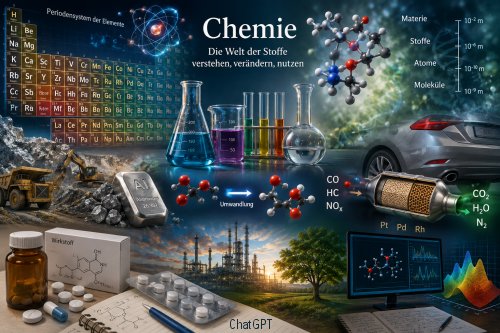
A branch of the natural sciences that investigates the forms of matter and the possibilities of transforming these forms into one another. It is essential that chemistry not be associated solely with
something artificial, and therefore possibly even unhealthy.
So everything that is matter is also associated with chemistry, even if its various forms are not actually converted into one another. The periodic table serves as a kind of inventory of matter, a look at its
composition.
Here, organic and inorganic chemistry are even still grouped together. It's about the spatial arrangement and bonding of atoms. From this, chemistry derives its regularities. And now, for the first time,
people are talking about substances instead of matter.
Here we can articulate the difference between chemistry and physics: Chemistry describes substances, their composition, and their properties, and asks about possible transformations. Physics studies
what these substances can do, what properties they have, and how they behave.
However, it should be noted that chemistry also investigates properties that originate from a substance’s structure, for example, how hazardous a substance is at a given dosage, these substances can
do, what properties they have, and how they behave.
Of course, the elements of the periodic table are rarely found in nature in their pure form; instead, they often require a wide variety of processes, for example, in the case of aluminum, which frequently
involve a high energy input.
Here, you can really see just how broad the field of chemistry actually is. In addition, once such substances have been obtained in their pure form as a collection of atoms, they can be reassembled. This
can then have a variety of effects.
For us humans, they are most readily understood as medications that, through their therapeutic effects, can, for example, relieve pain or treat inflammation. Female chemists and chemists lay the groundwork
for the development and production of medications.
The borderline with physics is perhaps made clear by a substance that is used in automotive technology to improve exhaust gases. We're talking about platinum, which is used in very small amounts in the
catalytic converter.
The conversion of carbon monoxide (CO) to carbon dioxide (CO2), the oxidation of unburned hydrocarbons, and the reduction of nitrogen oxides (NOX) to
nitrogen are chemical processes.
The development of the three-way catalytic converter for gasoline engines is attributed to John J. Mooney and Carl D. Keith, American chemists and engineers. Among other things, platinum, palladium, and
rhodium are used as catalytically active precious metals.
The conversion of carbon monoxide (CO) to carbon dioxide (CO2), the oxidation of unburned hydrocarbons, and the reduction of nitrogen oxides (NOX) to nitrogen are chemical
processes. Here, the line between physics and chemistry is blurred.
The study of electricity, too, often straddles the boundary between these two areas. We perceive it as a physical phenomenon in our everyday lives. At the same time, however, it also forms the basis for
the cohesion of atoms, both within atoms and in their bonds with one another, and thus for a key area of chemistry.
Finally, it’s worth mentioning that chemistry doesn’t just rely on experiments where something happens, but also makes extensive use of models, because the world of chemistry is often so small, and
as a science, it relies on definitions, theories, and, of course, mathematics as a useful tool.
|