The Chemistry of Water 3 The Chemistry of Water 3
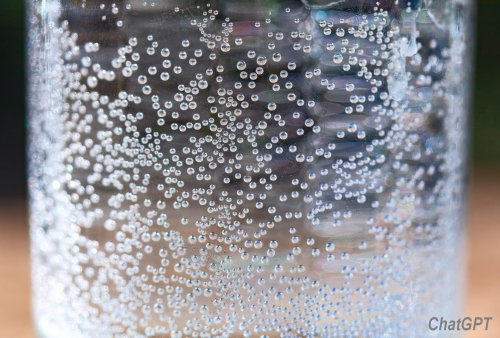
How does the 'carbonation' get into my favorite mineral water? If that were really an acid, it wouldn't be a good idea to put it in a drink, right? But it's just a misnomer. In terms of quantity,
it is dissolved carbon dioxide.
To be even more precise, it is only the dissolved portion of carbon dioxide (CO2) that is added under pressure during the bottling of the mineral water. 'Carbon acid' (H2CO3)
refers to the component that reacts with water.
So there are also acids that are completely harmless. Most of it is dissolved carbon dioxide, which, by the way, is also what creates the pressure in the bottle. When opened, the pressure conditions change
as carbon dioxide escapes.
CO2 rises from the water as gas bubbles and also escapes from the bottle. So, pour as much as possible out of the bottle at once, and as a general rule, keep the bottle in the fridge. Do not shake.
As a layperson in chemistry, one generally assumes that the substances you combine will react with each other. But the 'dissolution' of substances in water seems to occur in such a way that, in fact, the
water itself changes only very rarely.
Unlike salt, whose structure breaks down in water, and sugar, which forms crystals in water, the molecular composition of water remains unchanged. Even oxygen distributes itself as O2 among the water
molecules. The exception would be the small amount of carbon dioxide mentioned above.
Dissolving a substance in water may result in a reaction, but it does not necessarily have to. A chemical reaction, then, refers to a change in the internal structure of substances. The substances involved
form other substances (ChatGPT).
And if the spaces surrounding the reaction are closed, the total mass remains constant. If gaseous substances escape and their mass can be measured, the total mass before and after the chemical reaction
is once again the same.
Solubility depends heavily on the amount of the substances added. This means that salt can only be dissolved in certain concentrations; the rest settles to the bottom. However, anyone who has ever swum in
the Dead Sea knows that water can dissolve quite a lot of salt before it becomes 'saturated'.
When swimming, however, you tend to enjoy the tremendous buoyancy. But that brings us back to physics. Sand does not dissolve in water at all and sinks to the bottom, while oil is less dense than
water and rises to the surface.
It appears that solubility is greater in similar structures, such as 'electrical' ones. And returning to the topic of gases dissolved in water, we ask ourselves what the fish actually 'breathe'.
In any case, they, too, do not split oxygen from hydrogen, but live from the free oxygen O2 in the water. Under certain circumstances, they, too, may suffer from the heat because the water
is then less able to absorb free oxygen.
|