The Chemistry of Life The Chemistry of Life
| Please click - Subtitles available! |
To understand these as laypeople, we need to consider the food we eat. That doesn't mean there aren't other pathways into our bodies that we try to control, for example, through breathing masks, but we're
focusing only on this one.
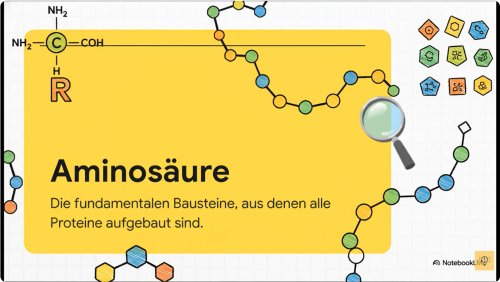
During the digestion of food, amino acids are formed from proteins. This is where the substances the body needs to perform its subsequent functions are created. The conversion to amino acids represents
a certain degree of standardization.
ChatGPT mentions 20 amino acids and classifies them as part of the 'standard biological set'. You probably also have only a limited number of tools in your toolkit that you use over and over again, while you
use all the others less frequently.
For the purposes of this discussion, please consider an amino acid as just a small building block and a protein as a chain of many amino acids. The term “egg whites” would then be the commonly understood
term for proteins, because they are found in large quantities around the yolk in a chicken egg.
Evolution has shown that proteins are particularly versatile and that they are not merely long chains, but can fold to form a very specific surface, a feature that is crucial to the unique functions of these proteins.
Although they are really just molecules,the same kind that conventional chemistry deals with, these ones have a certain quality. There is something about them that almost inevitably reminds us of life.
They can recognize and even modify specific other molecules, transport substances, transmit signals, bind to other proteins, and perform mechanical functions. The comparison to a toolbox is appropriate here.
For us, for example, in the creation of this book, AI has also become a very useful tool, but there is one important difference: AI acts from the outside, whereas the biology of amino acids tends to work from the
inside, through trial and error, elimination, and further development.
So, what exactly collides inside the human body? There are viruses, a controversial topic in biology regarding how, when, and why they originated. They have a specific 'protein shell', which is, among other
things, very
important for the body's defense mechanisms.
What does a virus 'want'? Nothing at all. It just passes right through (the liquid). For a variety of reasons, it can 'bump into' the surface of a protein. It manages to invade the cell and multiply there, which can be
devastating for the cell.
Antibodies do not need prior experience with the cells they attack. It is more a matter of chance whether, and how many of them are capable of detecting foreign molecules on the surface, or even pathogens.
And then they multiply.
Nevertheless, this is not a matter of 'searching' for such molecules, but rather a chance encounter facilitated by their sheer abundance. More of them remain after the illness. Of course,
vaccines help tremendously beyond just serving as a 'reminder'.
|