Wiring Diagram Wiring Diagram
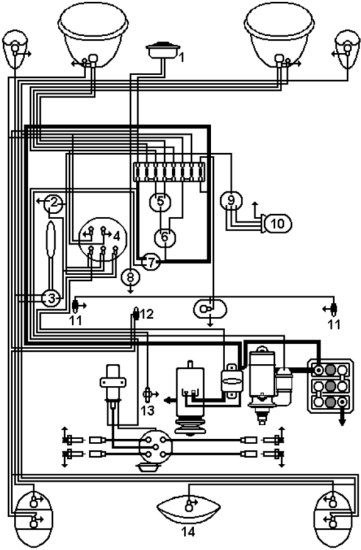

As you can see, the wiring diagram for a 1964 Beetle (VW 1200 A) actually fits on a sheet of DIN A4 paper, and if you follow the individual circuits, more than half of them, and six of the eight
fuses, are part of the lighting system. The situation is similar when it comes to identifying the components, although the turn signal light in the speedometer should actually be included.
This 6V system has a really nostalgic feel to it, even though the larger wire cross-sections are not even apparent here. Two indicator lights for the entire engine. What a brilliant solution, combining the
generator with the cooling fan, which means that if, for example, a V-belt breaks, you’re immediately warned that the cooling system is about to fail.
| Parking lights |
| Parking light indicator light |
| Low-beam headlights |
| High-beam headlights |
| High-beam indicator light |
| Fog lights |
| Daytime running lights |
| Cornering lights |
| Front turn signals |
| Turn signal indicator light(s) |
| Side mirror flashing light |
| Warning light |
| Taillights |
| Brake lights |
| High-mounted brake light |
| Rear turn signals |
| Reversing light(s) |
| Rear fog light(s) |
| Rear fog light indicator light |
| Interior lights |
| Front reading lights |
| Rear reading lights |
| Glove compartment light |
| Trunk light(s) |
| Switch lights |
| Dash light |
| Lighting for makeup mirror |
| Footwell lights |
| Ambient lighting |
This is simply a list of the lights to be powered in a VW Golf 6, with the two sides combined here. Not listed as the absolute pinnacle of complexity is the
lamp used to illuminate the lighting control.
In contrast, the construction is, in some cases, relatively simple. For example, the light switches transmit their positions to the vehicle electrical system control unit via thin cables (0.35 mm2). It then controls
the parking lights, daytime running lights, turn signals, tail lights, reverse lights, and rear fog lights via slightly thicker wires (0.5 mm2). The wire cross-sections for low beams and high beams are slightly
larger (1.5 mm2).
You can really tell that the turn signal is a product of a new era. There are some that just won't lock into place anymore. Or can still be tapped to lock into place, and flash three times shortly after being turned on. If they
remain turned on a little longer, they may also flash twice. You'll often look in vain for a flasher relay. In some cases, it was even connected to the hazard light switch.
The sound comes from the vehicle's electrical system control module through the regular speakers. It is even supposed to vary depending on which side you're on. If you aren't (yet) buckled in, it is accompanied by a
corresponding warning tone. It also deliberately makes it harder to hear the news, while the turn signal sound blends in accordingly. It's even supposed to be possible to deactivate it.
There was a change in the fuses during the Golf 6's production run. While many lights were initially protected by individual fuses in groups, the fuses disappeared first and then, with the installation of a new fuse box in the
engine compartment, the fuse slots disappeared as well. There are also two 30A fuses along the route to the vehicle electrical system control module, which controls the entire lighting system, separated by side.
At this point, we'll stop comparing the two circuit diagrams. We have shown how the most important basic functions have evolved over the course of about 50 years. We'll explain all the rest in additional chapters
because that would go beyond the scope of this discussion.
|