|
| 
|
 Alpina 3 Alpina 3
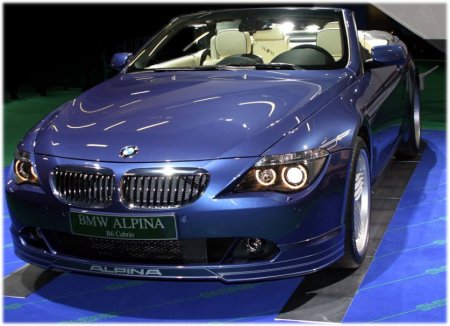
Alpina B6 S 4.398 cm3, V-8, 8,8 : 1, 2*DOHC 4V, 725 Nm 4750 rpm, 390 kW (530 HP) 5500 rpm, 6-speed automatic transmission, McPherson, multilink, Internally ventilated discs, 255/35
ZR 20 (9'')/285/30 ZR 20 (10"), 4,83/2,78/1,86/1,37 m, 450 l, 1.720 (470) kg, 318 km/h
| 1963 | BMW 1500 with twin carburetors |
| 1972 | BMW Alpina 3,0 CSL |
| 1984 | BMW B7 Turbo Coupé |
| 1987 | BMW Alpina B3 |
| 1995 | BMW Alpina B8 4,6 |
| 2002 | BMW Roadster V8 |
| 2004 | BMW Alpina B7 |
| 2012 | BMW D5 BiTurbo |
| 2015 | BMW B6 BiTurbo Edition 50 |
| 2016 | BMW B7 BiTurbo |
| 2019 | BMW B8 BiTurbo |
Alpina cars are something special. This time, it starts with the suspension. The suspension was adjusted from linear to progressive. This reduced the unsprung mass somewhat, but mainly resulted in the
ability to lower the vehicle without significantly reducing its payload capacity. This improved the top speed and, to a small extent, fuel economy as well. Also, when the trunk was heavily loaded,
the rear end no longer dipped as much because the suspension travel was generally slightly more restricted, but the suspension’s progressive response also came into play. Nevertheless, the suspension travel
remained virtually the same when the vehicle was under moderate load. Added to that was suspension tuning designed specifically for this purpose. Alpina said it had eliminated the BMW's 'comfort sway'.
The increased performance was complemented by a correspondingly improved braking system. In addition to the improved brake discs with larger cooling channels, a different airflow design was also implemented.
The 'perforations' in the disc surface allowed cooling air to enter from both the inside and outside, which then escaped through these openings. In addition, there were positive effects on the removal of moisture from
the discs. It is somewhat surprising that a tuning shop pointed to a top-gear ratio designed for *v*max, that is, achieving top speed at rated engine speed. However, it was argued that the vehicle had so
much power that a lower gear ratio wasn't necessary, and that it was therefore better to prioritize a longer engine life and lower noise and fuel consumption.
At Alpina, one evidently searched in vain for compromises. The tires and alloy wheels were designed to withstand even long drives, for example, 10,000 km, on recognized race tracks such as the Nürburgring's
Nordschleife. Another feature that set it apart from most production vehicles: The front tires were narrower than the rear ones. The reasons given were handling and the possibility of hydroplaning. However, they were
also adamant about not allowing the use of trailers.
Of course, the engines were the most important thing. Ultimately, the collaboration came about because the founder, Burkard Bovensiepen, was able to convince BMW executives of the advantages of a multi-carburetor
system in the 1500. Not far from that were adjustments to timing and compression. But the overall look that Alpina gave its vehicles seemed even more important.
After all, the tuner's vehicles managed to surpass factory-tuned ones, even though the latter have higher power ratings. Consequently, Alpina is now not only recognized as a registered manufacturer
of vehicles, but has also intensified its collaboration with BMW. Alpina products are installed at the factory; only the so-called 'delivery preparation' takes place at Alpina.
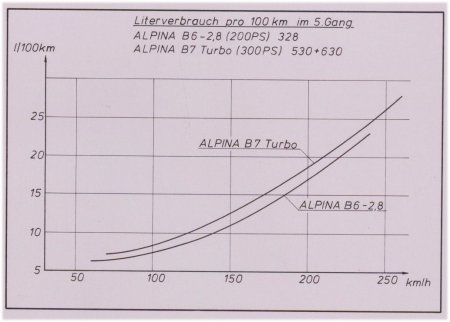
Let's take a brief look back at the period when the BMW E12 (introduced in 1972) was being refined. As the B7 Turbo, it was considered the fastest four-door sedan in the world. Before you criticize it for its fuel
consumption (Copyright Alpina), you should consider the tuner's argument, which suggested that the car's fuel economy is almost on par with that of a diesel vehicle, given its performance. The tragedy was simply
that it wasn't always able to make the most of that talent.
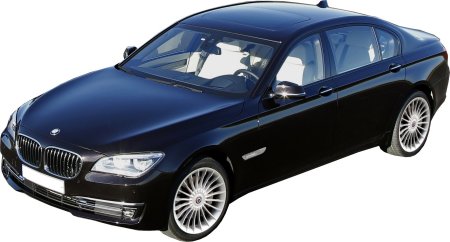
Alpina B7 BiTurbo 4.395 cm3, V8, 2*DOHC 4V, 800 Nm 3000 rpm, 447 kW (608 PS) 5500 rpm, 8-speed automatic, all-wheel drive, 255/40 R 20/295/35 ZR 20, 5,25/3,21/1,92/1,49 m,
2.110 kg, approx. 330 km/h, approx. 150.000 euros
800 Nm would be impressive even for a diesel engine. Here, that torque was combined with the torque characteristics of a gasoline engine, albeit limited by the turbocharger. But was engine speed even necessary
in a vehicle that, despite weighing over 2 metric tons, responded with tremendous thrust every time you pressed the gas pedal? Don't worry, that could also be done in a very controlled manner with the appropriate
treatment.
The same was true of the suspension, which, thanks to the air suspension, was by no means excessively stiff, despite the 20-inch inner diameter of the tires. The Alpina emblem, as the vehicle manufacturer, was
prominently displayed in the center of the steering wheel (and, depending on the configuration, also on the back). The car was only recognizable as a BMW from the front, on the hood. Added to this were the digital
indicator needles with an alpine blue background, though only in Comfort mode.
You could also take the 12-cylinder 7 Series, which would offer the same performance figures, but you'd have to pay an additional 16,000 euros. Besides, apart from the slightly modified front and rear bumpers, the
two weren't all that different. The question was which emblem offers more prestige: the 'M 160 Li' with the BMW emblem or the 'B7 BITURBO with the Alpina emblem. Overtaking battles at 305 or 320 km/h are out
of the question anyway.
We go even further back to the beginnings with the B7 Turbo Coupé, based on the 5 Series E12.
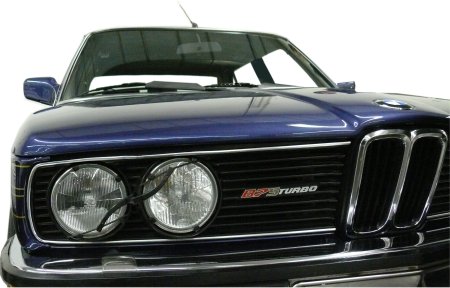
Back then, there were nowhere near as many turbo engines as there are today. The first Porsche Turbo is considered to be significantly above the normal engine range. It was precisely that output of 199 kW (270 PS)
that Alpina wanted to surpass. They thought they had a good chance of success and considered the inline six-cylinder engine to be the better basic design for adding a turbocharger.
Porsche later built boxer engines with two turbochargers, but with only one they had to accept the relatively long intake pipes and correspondingly less favorable response. In that respect, the BMW engine had it easier,
since it did not have to bundle the lines to and from the individual cylinders on either the intake or exhaust sides. The reward was 221 kW (300 PS) and a top speed of nearly 260 km/h.
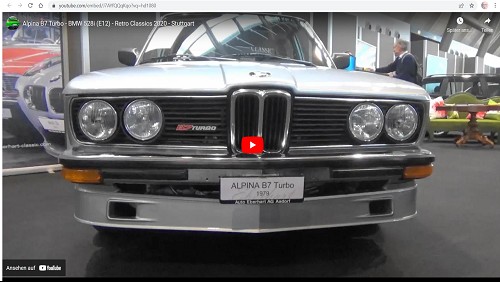
kfz-tech.de/YBM211
|
|