|
| 
|
 Austin
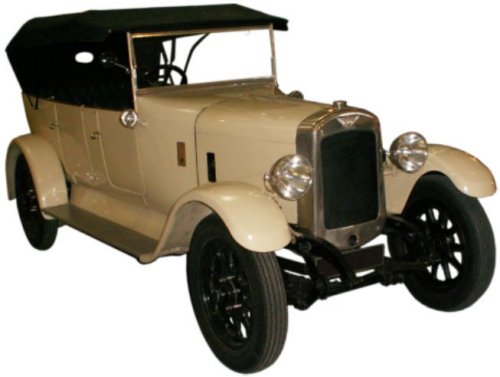 Austin Twenty von 1922
Founded in 1905 by the future Sir Herbert Austin, the company's production rose to over 1,000 vehicles per year by 1914. Austin had received his training as a mechanical engineer during
his time at his uncle's Australian company, Wolsley Shepard. Five years before he founded his own company, the Wolseley Tool and Motor Car Company had been established with him
as its director.
After World War I, the company struggled to maintain its prewar success and to secure enough work for the Longbridge, Birmingham, plant, which had expanded during the war. Success could
not be guaranteed with just the large and expensive Austin “Twenty” (pictured above) and the 1921 mid-range “Twelve” model. By then, the company had only 5,000 employees left, had accumulated
huge debts, and was under external administration.
To avert the company’s impending decline, Herbert Austin selected 18-year-old draftsman Stanley Edge — who, despite his age, possessed a solid technical knowledge — and moved to
his private estate, Lickey Grange, along with Edge, though not without the occasional assistance of Edge’s supervisor at the Longbridge plant. During the winter of 1921–1922, a new,
rather tiny car was created.
It is not known whether the tradition of the Peugeot Bebe (Baby), which dates back to Ettore Bugatti, from 1913 through the Quadrilette introduced in 1920 played a role here. All the big names
have also built small cars, including Ferdinand Porsche, who designed his Sascha car with a displacement of no less than 1,100 cm3. Could that have ultimately cost him his position at
Austro-Daimler, the company led by Castiglioni?
It's surprising that, despite all the cost-cutting measures, as with the Bebe and Quadrilette, they opted for a four-cylinder engine, even though a two-cylinder seemed to suffice everywhere else. However,
almost all of the Bestsellers mentioned above had four cylinders, with the possible exception of the VW Golf. Of course, you can probably guess what the first major engine overhaul was aimed at once
the Seven was in the hands of BMW.
It's said that Herbert Austin wasn't always the easiest person to get along with. Here, the boss was clearly the free spirit, who often had to be reined in by his employee. That didn't always work out. For
example, the car 'owed' Austin its unnecessarily complicated braking system, with the front axle braked exclusively by hand and the rear axle by foot, one of the first details that both BMW and Rosengart
later changed.
Apparently, he couldn't be dissuaded from the particularly steep windshield either. After all, Austin wasn't just the somewhat sidelined boss of the plant, but, even more importantly, the financier behind
the Seven project. In accordance with this and a number of patents, the factory paid him a little over two pounds for each car delivered (purchase price: 250 pounds).
The artist Stanley Edge thus lived and worked almost exclusively at Lickey Grange, where he was provided with meals and slept in the gatehouse. He was the one who
faithfully sketched out the approved ideas on paper and may even have laid them out in the billiard room, as the legend goes.
Originally, the Seven was supposed to be equipped with a 700 cm3 engine producing 7 HP, as its name suggests. A distinctive feature here, as was typical of British engines, was the
tax-advantaged, extremely long-stroke design. In fact, with its power originally rated at 7 HP (hence the name), the car was almost even better suited for the enormous power tax, one pound per HP, that had
just been introduced in 1921.
|
|