|
| 
|
 Public Transportation Public Transportation
Public transit carries only passengers and no cargo (except for mail buses) that is not related to the passengers. It is a fixed network of stops with fixed arrival and departure times. Taxis transport passengers on demand
to fixed departure and arrival locations. It is rather rare for taxis to pick up passengers from different locations during a ride. More often than not, they drop people off individually or in groups, as requested.
This is exactly where autonomous driving could fill a gap. Several people could be assigned to a trip independently of one another, although this would require their consent. This would require a system that would
determine the travel time for each individual passenger; in the case of partial automation, this would be subject to current traffic conditions. If everyone agrees, it would be possible to make better use of the
vehicle and offer a lower price.
A potential problem for robot taxis could be the eventual separation of autonomous and self-directed traffic, because there would then be limits that they could not overcome. Passengers traveling to destinations further
away would have to wait here for other vehicles and change. Furthermore, such a vehicle would be virtually defenseless against potential acts of vandalism. While it would be possible to mitigate this with cleverly
hidden surveillance systems, the result would be a slightly shabby-looking, vandal-proof setup.
After all, a ride request isn't anonymous, which, by the way, would bring data privacy advocates back into the picture. But this would provide a way to combat vandalism. By the way, unfortunately, you have to
expect that violence could also be directed at fellow passengers. Here, too, the registration mentioned above would be a godsend. Something like that already exists. When you board the bus or the
train, you hold a chip card up to a scanner, and do the same again when you get off. This allows trips to be billed with pinpoint accuracy.
However, an on-demand ride-hailing service like this would clearly be superior to public transportation, even if the latter could also be automated, which is already being tested on isolated rail lines.
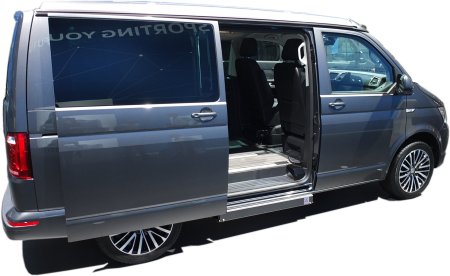
A new class of vehicles could emerge, ranging in size between large taxis and buses, and replacing the latter during off-peak hours. That would make public transportation available around the
clock. With prices that would be inversely proportional to the frequency of each transportation case. Taxi companies are already acting as service providers for public transportation, as are private
bus companies.
Gone are the days when the main public transit operator essentially always used buses of the same type, apart from variations in length. More flexibility would be expected from him with regard to
vehicle sizes and features. Pick-up times and locations are agreed upon, which he could then combine in an economically efficient way with the route with the probably most request. Of course, this does not refer to
requests for immediate orders, but rather for orders to be filled the next day at the earliest.s
In this context, access to transportation modes with strict time constraints, such as airplanes, would be given top priority. After all, that would be a ride comparable to one in a private car or a taxi. With
the latter, you can already make arrangements for your return flight today, though it can be a bit tricky in the event of delays or diversions. So here, too, it all comes down to networking.
This likely significant level of customization in public transportation would be possible because there would be no need to rely on human drivers. Apart from breakdowns affecting the specific vehicle needed, for example,
there would be no sick calls, which sometimes present dispatchers with insurmountable challenges. It doesn't help much that even members of the executive board at such companies today have a bus or passenger
transport license. It's probably meant more for strike actions, but it doesn't help much in that case either.
We can therefore conclude that not only will public transportation and taxi companies be working even more closely together, but this will also mean more competition. The various forms of carsharing
will also offer more viable alternatives here in the future. In this context, trips will be divided even less than before, for example, only between private cars and a single public transit provider. The world of public
transportation is becoming more diverse and, hopefully, much more effective for users thanks to connectivity.
|
|