|
| 
|
 Porsche 1 Porsche 1
kfz-tech.de/PAR214
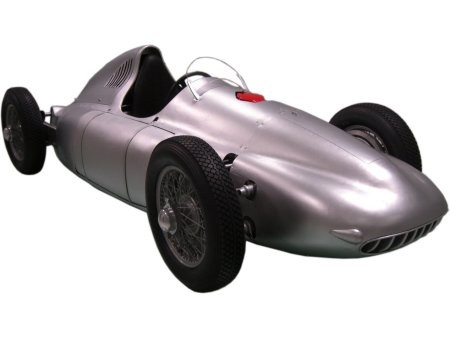
Porsche Cisitalia B-12, 1,493 cm3, 7 crankshaft bearing (Hirth), 2 * dohc (linkage lever), 4 V, 2 Roots compressors, 1,8 bar, 2 Weber downflow, dry sump, 25 liters, 283 kW (385
HP), 10.500 rpm, midsized engine, longitudinal, all-wheel drive, five-speed, tubular frame, magnesium, wheelbase 2,59 m, approx. 720 kg, approx. 250 km/h, 1947
Are we referring to the manufacturer of fast sports cars founded after the Second World War, the vehicle development company founded in 1931, or the work of Ferdinand Porsche in general? It’s probably the latter, since
we’re talking about all-wheel drive here, and Porsche had already implemented it in at least one of its electric cars built by Lohner with wheel hub motors.
We will set aside the other contracts he fulfilled for the Austro-Hungarian military, as well as his work as a tank designer for the Nazi government; we have already reported on his involvement at VW. And so we find
ourselves in the period following Professor Porsche’s time.
We turn our attention to his son Ferry, under whose leadership the technically rather unfortunate but, in terms of securing his father’s release from prison, highly beneficial Cisitalia project emerged. Piero Dusio had made
so much money from the manufacture of textiles, particularly military uniforms, that, as an avid race car driver, he was able to have a car custom-built. And this was in 1946, a time when people normally had
completely different concerns.
It was the project 'Consorzio Industriale Sportiva Italia'. With the help of Carlo Abarth and Rudolf Hruska, one got in touch with Ferry Porsche, who had found refuge with his father’s
associates in Gmünd (Carinthia); he, of course, accepted the commission. The result was a race car designed for the newly emerging Formula 1 series, equipped with a 1.5-liter displacement and 12 cylinders (pictured
above).
A special feature of the project: It was a mid-engine, the connection of which to the front and rear axles was particularly tricky. It had finally been completed and the development costs had been paid off, but it never really
achieved any real success, especially since Formula 1 has never been particularly fond of all-wheel drive. Cisitalia didn't survive for long either.
There’s a long break before we get to Porsche’s next project. There had already been talk of this, namely, the German Bundeswehr contract to replace the DKW Munga. The Porsche design for this was designated 597
(Jagdwagen). You have to take a moment to think back to the 356 era. The 911 didn't exist yet in 1956. This is pure Volkswagen technology.
Or maybe not? After all, the Porsche technology developed up to that point was quite diverse and extended all the way to the 550. This made it possible to deviate from the basic layout of the amphibious vehicle or
'Kommandeurswagen' already described by VW and, for example, realize a five-speed transmission. Of course, a detuned Porsche engine was used, although a setup with two carburetors was quite unusual for an off-
road vehicle.
Long story short, the project failed, mainly because of the costs. It is said to have become about twice as expensive as the cheapest of its competitors. Elsewhere, rumors are circulating that the
Porsche from Swabia was deliberately disadvantaged during the tests because, after all, the Audi Iltis came from Bavaria, as did the defense minister.
Now we should really be starting a new chapter, because that’s exactly what Porsche’s all-wheel-drive story is doing. For a long time, there was no news here about this technology, even though the company played an
enormous role in the further development of the automotive industry. After all, there is the development center in Weissach, which conducts development work for all kinds of manufacturers.
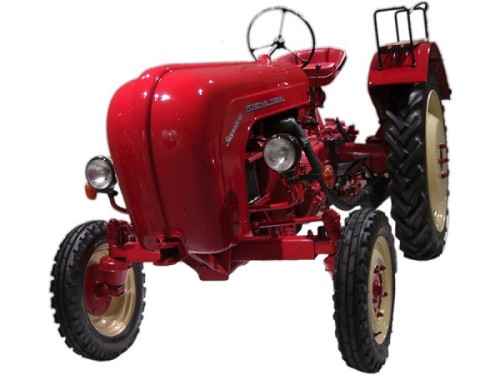
We almost forgot about the Porsche tractor. It was available as a prototype in 1961 under the name Diesel Master, with four-wheel drive from ZF and a specially manufactured transmission for it. Like all four-wheel-drive
vehicles with a rigid front axle, it can be identified by the massive axle drive, which is slightly offset to the left relative to the direction of travel. The project was not carried out because Porsche withdrew from the tractor
business.
| The Porsche tractor without all-wheel drive |
kfz-tech.de/PAR215
|
|