|
| 
|
Allrad 2 - Jeep 4
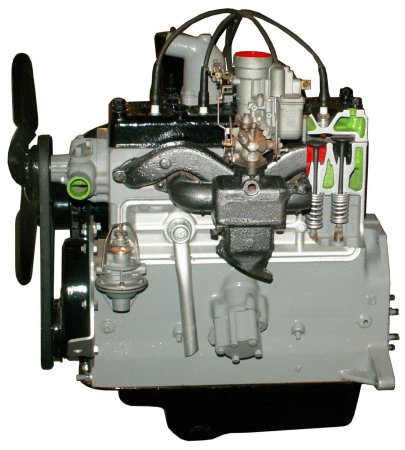
Willys Go Devil Motor 2.199 cm2 (79,4 mm * 111,1 mm), R4, 6,48 : 1, sv, liquid cooling, 142 Nm at 2000 rpm, 41/45 kW (56/61 hp) at 4000 rpm, 1940
Despite such a difficult start, it ultimately turned out well. Who knows just how much the Jeep contributed to the Allies’ victory. It is said to owe its name to the brash wording of the Ford designation 'GP,' short for 'General
Purpose'. There are other attempts at an explanation as well.
Let’s ignore the love individual soldiers had for his Jeep and the other, ultimately unsuccessful variations.Let’s ignore the love individual soldiers had for his Jeep and the other, ultimately unsuccessful variations.
Nevertheless, significant things happened during the war and toward the end. For example, Willys had the name patented. Plans for civilian production were also considered relatively early on.
It is surprising, yet understandable, that Ford did not make any claims after the war. The patent in question may have been a reason. Perhaps even more important, however, was the fact that the company wanted to focus
on the expected, massive demand for passenger cars and vans. This success ultimately proved Ford right as the No. 2 automaker in the U.S.
And Bantam? Some of the 1,500 Jeeps took rather adventurous routes to Europe and Russia. After that, they never made cars again. In 1956, the company was acquired by a steel manufacturer.
So that left only Willys. Here, preparations for postwar production had begun relatively early on. From late 1945 to 1949, there was a boom.
Willys had a problem: producing sheet metal parts in large-scale production. Before the war, suitable suppliers had been found. However, they preferred to supply larger quantities than Willys could handle. And investing in
own presses wasn't worth it. Finally, manufacturers of sheet metal, for example, for washing machines, were found who could supply sufficient quantities.
After all, American washing machines are a bit larger than European ones. Still, you got the feeling that you could tell just by looking at the Jeep’s successors, especially the station wagon, that it was a Jeep up front,
but maybe a refrigerator in the back? Unfortunately, one even tried to imitate the wood design of the others.
But it’s easy to mock the vehicles produced immediately after the war. The closed-body version was joined by an open-body pickup, which, unlike the former, retained all-wheel drive. And, of course, it remained the civilian
version of the Jeep. Other new additions included a six-cylinder model and the Jeepster, a type of roadster with a hardtop.
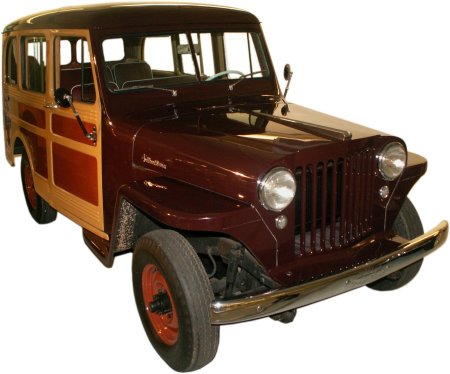
Incidentally, toward the end of the boom, the station wagon was also available in an all-wheel-drive version. The company was therefore justified in claiming that it had launched the first Sports Utility V
ehicle.
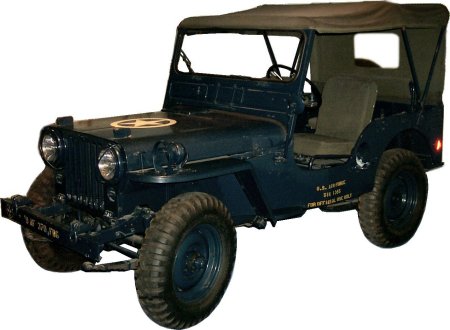
The postwar Jeep evolved from the CJ-2A to the CJ-3A
Starting in 1950, a new conflict gripped the world: the Korean War. It was a stroke of luck for Willys, as there was a huge demand for the now-improved Jeeps. They had grown a bit larger
and now had an OHV engine called the 'Hurricane'. After all, it now produced 53 kW (72 hp) instead of 46 kW (63 hp).
Anyone looking at the model program in later years will easily come to the conclusion that, over the years, it was essentially the Jeep that was produced, with everything else being secondary products. It would be a
misleading impression, as he would be ignoring the desperate struggle to expand the product line, for example, even to include 'ordinary' passenger cars.
However, there were also countertrends. For example, the GoDevil engine (top image), which was repeatedly added to the product range in place of or as a supplement to the Hurricane. It wasn't until the 1971 model year
that it finally disappeared, actually a bit late for a side-valve engine.
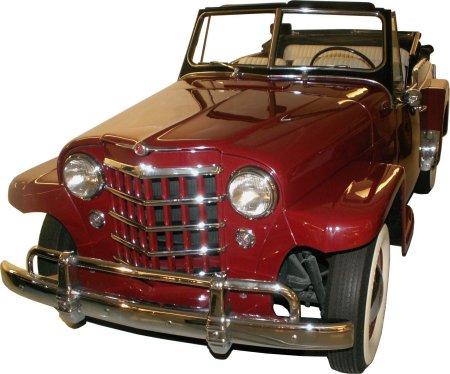
If, as in the U.S., a new model is expected every year, you shouldn't expect too many new features. Frequent model changes tend to focus more on changes to less technically significant components, such as a tapered
grille (pictured above). It's mainly about making it look good. The new model must be recognizable as such.
|
|