|
 DKW Munga DKW Munga
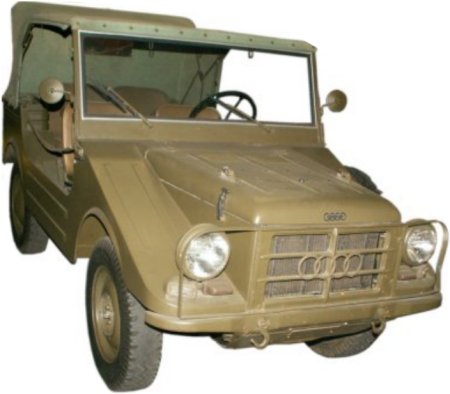
DKW Munga 896/980 cm3 (71,0/74,0 mm * 76,0 mm), R-3, 6,5/7,25 : 1, heat circulation, 71/80 Nm at 3000 rpm, 28/32 kW (38/44 hp) at 4200/4500 rpm, dual carburetors, 2 * 4+reverse gears,
3.38/2.00/1.81/1.68 m, transverse leaf spring/wishbone front/rear, drums, 6.00 R 16 (5"), from 355-690 kg, 1025-1220 kg, 45 liters, 90/98 km/h, from 8.340 DM, 1954-1968
| Auto Union = DKW + Wanderer + Audi + Horch |
This will be a long story with the Mehrzweck-Universal-Geländewagen mit Allradantrieb (multi-purpose all-terrain vehicle) with all-wheel drive, and we should actually start with the regular
DKW passenger cars. Because the key to success, which much later became known as 'quattro', lay in their conversion from the two-cylinder transverse engine to the more powerful three-cylinder.
Although three, four, or even eight cylinders were now possible, the developers opted for the longitudinal engine, a handicap that is still slightly noticeable today at Audi. The engine was positioned in front of the front axle,
but the transmission was behind it. In principle, extending the engine's output shaft rearward could directly lead to all-wheel drive.
We'll see what incredible variations are possible, even on a small scale. But first things first: It's not actually that direct, because the front and rear axle would be then directly connected to each other.. In our book 'Allrad 1',
we've already demonstrated, for example, when cornering, why this led to tension. These tensions were supposedly compensated for in the Munga by shafts that aren't entirely bend-resistant.
We'll see what incredible variations were possible, even on a small scale. But first, the most important thing: It wasn't actually that direct, because that would have directly connected the front and rear axle. In our book 'Allrad
1', we've already documented, for example, during cornering, why this led to distortions. These were supposedly compensated for in the Munga by shafts that weren't quite as rigid.
This was clearly a permanent, non-disengageable all-wheel drive. How the supposedly flexible shafts achieved this remains unclear. In any case, there were only universal joints everywhere, even on the outside of the front
wheels. It's important to understand that this project was under enormous time pressure, and that DKW, after relocating and rebuilding in Ingolstadt, had now become a partially Bavarian automobile factory. The then
Defense Minister Strauss is said to have been particularly committed to Auto Union as a Bavarian.
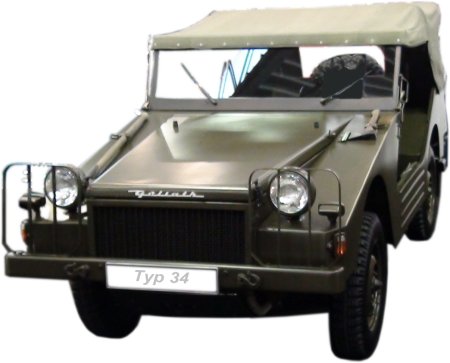
This is the Goliath Type 34. Its predecessor had such severe failures during testing that the modifications prompted a new type number. It even received a four-stroke boxer engine, because the original two-stroke,
featuring the first-ever direct gasoline injection, proved unstable. While it had a switchable all-wheel drive, it also lacked a center differential. Apparently, its shafts were more bend-resistant than those of the Munga, which
caused serious defects.
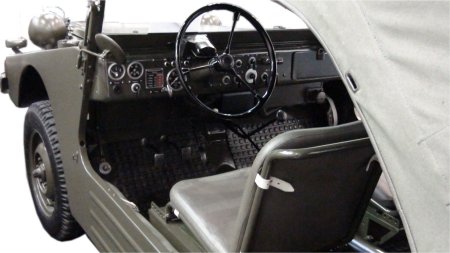
The Porsche 597 pictured below would actually have been a more suitable car for the task at hand. While it stands out a high price, it also featured a proven concept, essentially that of the VW Commander or
Schwimmwagen (see chapter VW 1). In the second development stage, a 1.6-liter four-stroke boxer engine tuned for more torque rather than power was installed in the rear. It featured selectable front-wheel drive and a
five-speed transmission with a very low-geared first gear.
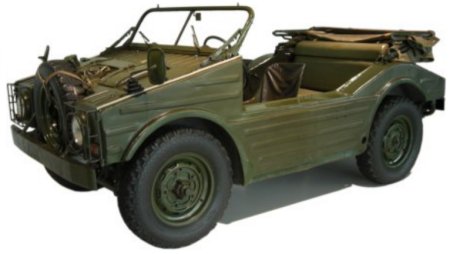
The inspectors saw things differently. They criticized the rear-mounted engine, which was loading resistant, and the fuel tank at the front, and also noted damage to the self-supporting body, for example, which prompted
Porsche to change suppliers. The floatability of the first version was considered a disadvantage due to the lack of doors. However, Porsche suspected that the 597 had been subjected to particularly heavy wear and tear.For
example, it had been left idling for long periods to conceal the Munga's higher fuel consumption.
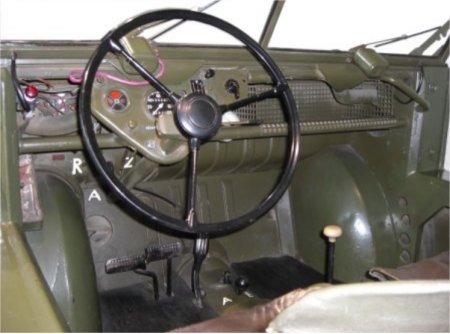
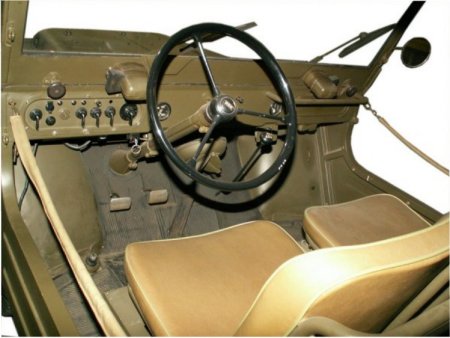
Regardless, the Munga won. After all, the military also demanded the Munga's off-road gear, indicated below by a two-speed gearbox folded upwards on the left. This allowed all gears to be downshifted so far that even 3
km/h (1.9 mph) was possible in first gear.
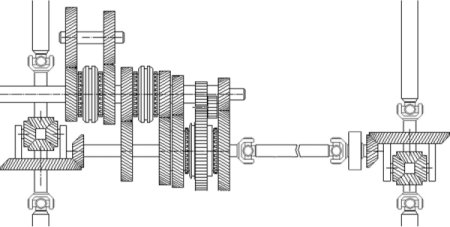
Was the DKW Munga a blueprint for the Audi quattro? Perhaps only to a limited extent, given that it was built without a center differential and exclusively with universal joints, and then, despite a wheelbase of only two
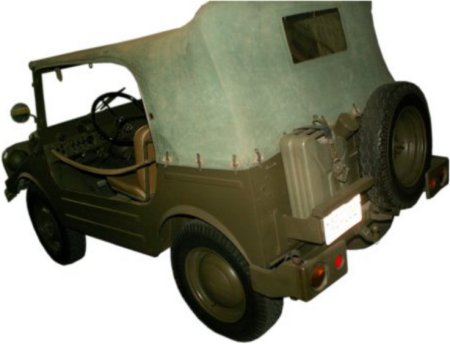
meters, its turning circle had to be limited to 12.5 meters. Incidentally, the vehicles only entered private use after they had been decommissioned from the German Armed Forces.
|
|