|
A B C D E F G H I J K L M N O P Q R S T U V W X Y Z
 Ford Cortina Mk 1 Ford Cortina Mk 1
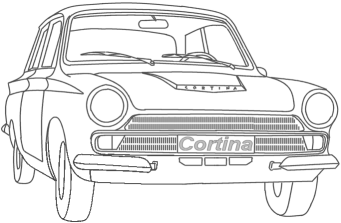


| Ford Cortina |
| Engine | In-line four-cylinder |
| Displacement | 1198 / 1498 cm³ |
| Bore/stroke | 81 * 72,6 mm |
| Compression | 7,3 / 8,3 : 1 |
| Engine control | Central camshaft,
Spure gears, OHV |
| Torque | - / 84,5 Nm at 2300 rpm |
| Max. power | 35,5 / 44 kW (48,5 / 59,5 HP) |
| Rated speed | 4800 / 4600 rpm |
| Powertrain | Front engine with rear drive |
| Transmission | Four-speed, steering column-mounted gear |
| Front suspension | McPherson-spring-strut |
| Rear suspension | Rigid axle, leaf spring |
| Brakes front | Drums, starting in 1965 discs |
| Brakes rear | Drums |
| Top speed | Approx. 130 km/h |
| Manufactured | 1962 - 1966 |
| Versions | 2/4-doors, 3/5-door van-like, Van |
One do not see the car's relatively short development time. Also from the significant savings on parts you notice nothing at first glance. Even the reduction in weight is not immediately clear with the relatively quiet engines. It's just a car, that will be built with limited production costs. This keeps the technology conventional and up-to-dateness is only admitted there, where costs can be reduced.
It's not the first time that relatively simple products get a very classy sounding name. And since Ford in Britain is determined clearly on the 'C' as in 'Corsair' and 'Classic ', receives the new the name of the Winter Olympics City 'Cortina d' Ampezzo'.
cartecc.com
Top of page
Index
2001-2015 Copyright programs, texts, animations, pictures: H. Huppertz - E-Mail
Translator: Don Leslie - Email: lesdon@t-online.de |

|
|



 Ford
Ford "Great Britain view - click to enlarge!")