|
|
Sheathed Type Glow Plug
Assignment
The glow-plug, as a part of the glowing equipment should, particularly at low temperatures, cause the combustion chamber of the diesel engine to be heated quickly, thus reducing the previous 'pre-
glowing' time to a minimum. The internal combustion chamber of the direct-injector cools far less than the previous, external pre-combustion chambers.
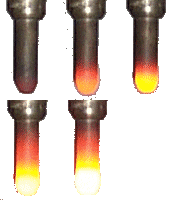
| Heating coil made of chromium-aluminum-iron, control coil of nickel |
Even at temperatures of -25°C, pencil type glow-plugs with a control device can heat up a cold combustion chamber within 2 seconds, at above -5°C they are only used for after-glowing. In the
meantime, the post-heating phase of the glow-plug is far more important because it contributes a great deal to the compliance to exhaust gas regulations. The energy feed to the ceramic glow-plugs is
adapted to the respective working conditions.
Function
Ever since the glow-coil has been made up of several, tightly wound coils, the 'glow plug' has been renamed the 'glow plug'. The high current consumption is possible because the diesel engine has a
much higher battery capacity than the petrol engine. The glow plugs are arranged in a parallel circuit, so if one breaks down, the others will still function.
| Control by pulsing (pulse width modulation) |
The nominal voltage can be far less than 12 V, indeed, 6 V, or even less, is possible, this allows operation for a short time at the beginning of the glow phase with no adverse effects on the full on-
board voltage. Thereby, the temperature in the combustion chamber, rises very quickly. To avoid damage to the glow-plugs, these are regulated down after about 2 seconds by the control device.
| Temperature between 1.000 and 1.200°C |
When Diesel particle-filters are used, the regeneration takes place more often. In this case the glow-plugs can be used for support. The service life of the ceramic heating elements is almost
unlimited, however, because of the danger of breakage, they must be very carefully handled in every-day workshop life. The removal of modern glow-plugs is also a risky business. In the meantime,
there are a number of tools which can be used to remove them, albeit, bit-by-bit, so that the cylinder head does not have to be replaced or even removed. By the way, one should exercise great
care when fitting new ceramic plugs, afterwards they must always be tested.
| Control unit due to high current supply as close to the glow plug |
The glow-plug is an example of a PTC (Positive Temperature Coefficient). It has a low resistance at the switch-on time, of less than 10 Ohms. This increases quickly with rising temperature, limiting
the current consumption. Nonetheless, in addition, the control device regulates the glow-plug through the glow-relay.
Important
Individual defective glow-plugs can hinder the cold starting procedure considerably, particularly in the case of the pre-combustion chamber system. Because glow-plugs work, as opposed to spark
plugs, only during cold starting, only the defective plug(s), determined by measuring the resistance, must actually be replaced. Glow-plugs removed from modern diesel engines may not be connected
to a 12 V power source.
Error detection
Because of the above described risks, one should not remove the glow-plugs until one is certain that they are defective. As before, one can disconnect the individual glow-plugs for the purpose of
measuring the resistance. Should one decide against this, the results using a caliper-gauge, will depend on whether one gets a current-flow reading from all the plugs or from only one. One can safely
calculate with the amount of cylinders multplied by, at least, 10-15 Amp. for the first two seconds as the nominal value, afterwards then, respectively less.
Take note, that a complete lack of current or voltage does not always mean that the control device is faulty, the problem can also lie in the glow-relay or it's fuse.
New
Up to now, we only knew the glow-plug as an actuator. Well, nowadays it is - like the spark plug - also being used as a sensor. 04/12
|
|