Transverse Control Arm (Wishbone)
| Pressed sheet-metal or aluminium part |
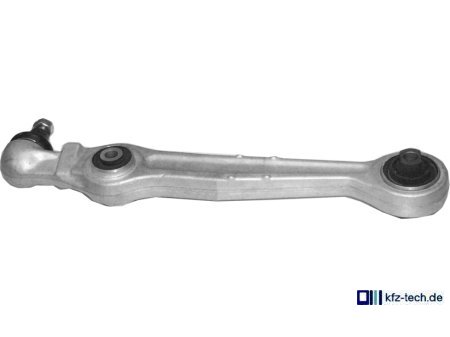
This construction method can still be found, made from two halves of pressed or spot-welded sheet-metal. In the meantime, there are wishbones made of aluminium (see
figure below). This offers more protection against corrosion - and twice as important - is lighter. It used to be made from forged steel and was heavier and more
complicated.
| Rubber bearings are more flexible |
Here is, at least the second generation of rubber bearings at work. As can be seen on the left pivot-bearing, it is mounted at a certain torsion angle. Looking at the enlarged
picture (click twice), one can see that the vulcanised rubber insertion reacts to kick movements to the left and to the right softer than it does to an up-and-down movement.
Varying flexibility, in all four directions occurs often in the chassis frame.
| Ball-head replacement, correction of the camber |
Right at the top of the wishbone, we see the bearing for the replaceable supporting ball-joint. Judging by the shape, this is probably the left wishbone (McPherson-strut). Should camber corrections to the wishbone be possible, they are carried out by way of elongated holes for the supporting
ball-joint or by shifting the complete wishbone assembly.
| Stabiliser as part of the wishbone |
One question does seem to be valid: does the second figure actually show a wishbone? It is of course, only a part of it. The other part is formed by the stabiliser. It is threaded on one end and is bolted on to the bushing with the rubber bearing on the right next to the ball-head. Together with the
suspension strut, this wishbone probably makes up the simplest possible front suspension. 10/10
| The wishbone is a typical part of the independent suspension. |
Pressing out the old supporting joint
|