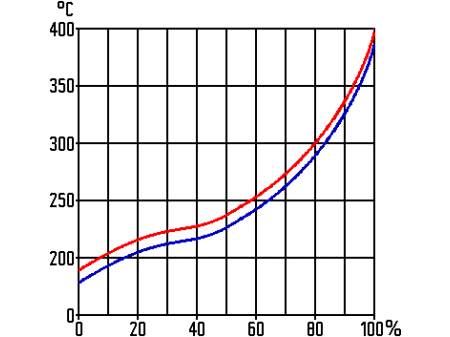
Boiling range/boiling temperature
of summer diesel/winter diesel |
| Cetane | Calorific value | Density at 15°C | Sulphur |
| Diesel | from 51 | 42.800 kJ/kg | 0,82 - 0,84 g/cm³ | <350 ppm |
| Super-Diesel | from 58 | 42.800 kJ/kg | 0,82 - 0,84 g/cm³ | < 10 ppm |
Assignment
Also in case of low temperatures and a low compression ratio, (causing fewer nitrogen oxides in the exhaust gas) starting the
diesel engine should not be problematic due to a special ignition willingness and a low maximum boiling temperature. To ensure noise reduction, a short ignition delay is important. After successfully starting the
cold engine, the fuel filter should not clog. It is desirable to have low sulphur in the exhaust gas, because of the exhaust gas treatment. The life span of the injection system can be significantly elongated with a good
lubrication. These characteristics should be guaranteed in all countries in a norm and be kept with as few deviations as possible.
Function
Diesel is distilled like petrol mostly of oil. However, diesel can also be won of natural gas, liquefied petroleum gas or consist of biological diesel fuel. Mixtures are possible, too. The higher ignition willingness compared with gasoline is reached by lower
interlinking of the chain-shaped hydrocarbons. Additives, for example flow improvers, are added to the diesel during the winter in order to lower the pour point. Diesel can become viscous at low temperatures by
elimination of Parafin, and block the filter.
The mixture for the petrol engine should be less prone to ignite than the
mixture for the diesel engine. Therefore, diesel should have a high cetane number. The self-ignition temperature for compressed dieselis at most approx. 400°C and for petrol minimally approx. 500°C. The flash point
of diesel lies at 55°C. Thus, diesel belongs to danger class AIII.
Important
Diesel is not cheaper, but more expensive in the extraction and production than petrol. The price difference results from a substantially lower tax. This has originated from a subsidy for the transport trade.
Specific heat value
The specific heat value of diesel lies with 42,500 kJ/kg somewhat below that of normal petrol. Please notice that refers to the massa and not to the volumn. So there is more specific heat value in a liter diesel than
petrol.
Special feature
There are utility vehicles, which use even the diesel fuel for cooling control units. 11/11